


Any business where the customer buys more than once, from subscription brands and SaaS companies to distributors with repeat accounts and services firms on retainers, has one number that matters more than this month's revenue: how many customers come back.
In most of these companies, someone pulls every order out of the billing system, works out which customers came back, and types the result into the financial model. The update takes an afternoon, so it happens once a month.
Then the CEO asks whether customers from the spring promotion stick around longer than the rest, and the model cannot answer, because it holds one average for every customer.
Retention is a calculation that runs over every order the company has ever taken. A spreadsheet stores the finished numbers well and computes them poorly from hundreds of thousands of order rows, so the computing happens by hand, somewhere else, once a month.
The Fix is a Finance Operating System, Pointed at Your Transactions:
It connects to the systems where the orders already live, so nothing gets migrated.
It applies the company's definitions of a new, repeat, and lost customer to every order, as code, every night.
It hands the financial model the retention numbers that drive the revenue projection. Next year's revenue is new customers each month, times the share that keep paying, times what they pay, so those first two numbers are most of the forecast. A person makes the decisions on top of them.
How We Would Build It
Same four parts as the finance OS we laid out in August, pointed at customer behavior, and here is how we would build it.
Connectors copy every order out of your systems. A connector is a small piece of software that logs into a system the way a person would and copies out the records on a schedule. We point one at the billing system, one at the CRM, one at the payment processor, and one at the accounting system. They run every night, so nothing gets exported or pasted by a person.
One place holds every order and applies your definitions. Every order from every system lands in one place, in the same format (we use Supabase, a hosted database). The definitions (what counts as a first order, a repeat, a renewal, a cancellation, a refund) are written down once as rules, and the database applies them to every order each night, so the retention numbers come out the same way every time.
Agents flag what changed and draft the note. An agent is software that reads the finished numbers, notices when one moved, and drafts the explanation, the way a junior analyst would. The agent never computes the retention rate. When customers who first bought in the same month come back less than earlier groups did, the agent pulls the orders behind the drop and drafts the note to the CFO.
A web page shows the results. The team opens one page, like a dashboard, with the retention table, a chart of whether spring-promotion customers stay longer than everyone else, and a choice of how much history the averages use, six months or two years. We build it with an AI coding tool and host it on Vercel behind a login.
The model reads the numbers. Excel gets the two numbers the revenue projection runs on: how many new customers arrived each month, and what share of them are still paying one, three, six, and twelve months later. They land in the rows that are typed in today, and the scenarios stay in Excel.
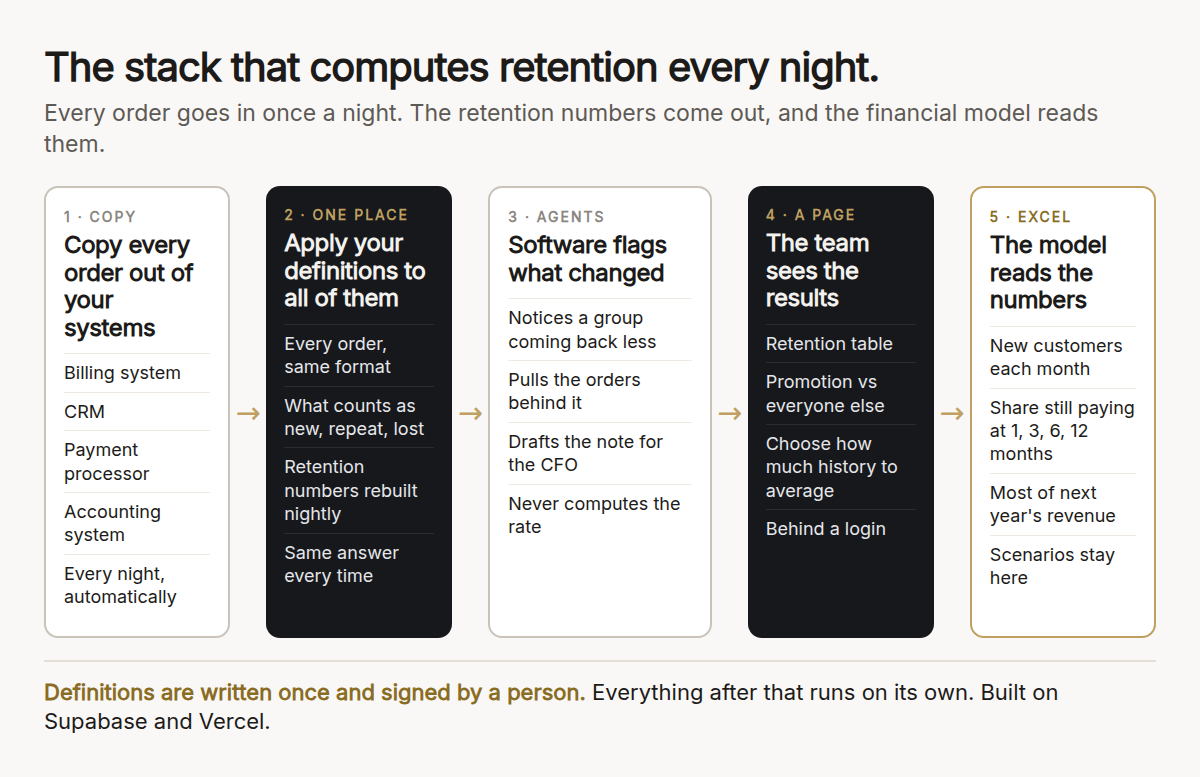
Every order is copied out of your systems each night, your definitions are applied in one place, software flags what changed, a page shows the results, and the model reads the numbers. Illustrative, fictional company.
What Changes for the CFO
The CEO's question gets answered the same day. Whether spring-promotion customers stick around longer is a question the system can answer from orders it already holds, so the answer takes minutes instead of waiting for the next monthly rebuild.
The diligence table already exists. The first thing a buyer asks for on a recurring-revenue business is retention by customer group over time, and the table is already live on the same definitions since day one, so nobody rebuilds it the week before a sale.

The numbers the model needs, typed in by hand today and computed from every order every night with the operating system. Illustrative data, fictional company.
What a Finance OS Does Not Do
The OS does not replace the financial model or the billing system, and it does not decide which promotion to keep. A person writes the definitions once and signs them, and the OS applies them every night.
Key Takeaways
Retention is math over every order. A spreadsheet stores the finished numbers well and computes them badly, so a person computes them by hand once a month.
Every order is copied out of your systems each night, your definitions are applied in one place, software flags what changed, a page shows the results, and the model reads the numbers.
The first version takes 30 days: the definitions get signed, the first retention table runs, and the model picks up the numbers on its own for the first time.
The Number

This Week in AI-Native Finance
Customers Bancorp said on its October 23 third-quarter call that cycle time in its AI-powered loan underwriting process is down 95%. The bank also reported 76,000 cumulative estimated hours saved by AI and automation, up from more than 46,000 in the second quarter. The footnote on its slides says the hours are self-reported estimates from employee surveys that were not re-measured. Pre-tax profit per employee was $464,000 annualized in the third quarter, up 34% from $346,000 in 2025.
SAP said on its October 21 third-quarter call that it is seeing productivity gains of 20% across central functions such as finance, HR and procurement. SAP said its Joule Work Desktop assistant is live for more than 110,000 employees. Coverage dates both figures to SAP Connect on October 6, and the call gave no baseline or sample for the 20%. Management also said it is confident of up to €3 billion in efficiency gains over the next two years.
Barclays said on October 22 that it plans to cut about 5,000 jobs, roughly 5% of its workforce, by the end of 2026 in what CNBC calls an AI efficiency push. About 1,000 roles went in the first half and about 4,000 more are expected by December, about 60% in support functions including developers. CEO C.S. Venkatakrishnan said "AI is the icing on the cake, not the cake," calling it one part of a wider efficiency drive.
Only 3% of CFOs say they are actively reducing headcount where AI has replaced finance work, according to Datarails' 2026 CFO Sentiments survey as reported by the Journal of Accountancy this month. Sixty percent say they have redeployed staff to higher-value work, 9% have frozen hiring without cutting, and 96% say they spend at least 10% of their time verifying or correcting AI output. The survey covered 270 U.S. finance leaders at companies above $100 million in revenue, and two years ago 57% of the same survey's respondents expected AI to reduce finance roles.
Anthropic publicly filed its S-1 on October 26 and plans to list on the Nasdaq Global Select Market under the ticker ANT, with a listing expected in November. The filing shows $16.3 billion of revenue in the first half of 2026 and a net loss of $80.7 billion over the same period, most of it a non-cash charge of about $72.4 billion tied to convertible notes. The company reported $974 million of operating income in the second quarter. It lists roughly $417 billion of future payment obligations to compute providers. No price range or share count is set yet, and the revenue-counting dispute with OpenAI we covered two weeks ago now has a public document on one side of it.
What We're Reading
CFO Dive reports that Anthropic said all four of its disclosed agent incidents involved a misconfigured third-party testing environment that allowed internet access. The piece lists controls for finance: narrow permissions for each agent, human approval of payments that name the recipient and amount, audit records the agent cannot alter, and tested ways to revoke access.
Workday CFO Zane Rowe says success with AI is defined by better work, stronger decisions, greater organizational capacity and improved customer value, and that a finance team producing twice as many reports has not made the business better. He recently reviewed a list of 10 AI agents his tax team is developing, and not every one will make the cut.
Cloud Wars reports that Microsoft's corporate vice president for AI ERP, Georg Glantschnig, argues that agents make the ERP core more important. Posting and allocations stay rules-based in the ERP, agents handle interpretive work such as matching mismatched transactions and processing supplier invoices in varied formats, and agent access stays under the same identity and permission controls.
Christian Sanford and Kenny Jen are the co-founders and managing partners of QuantFi, where they help PE- and VC-backed companies build investor-grade finance functions powered by AI-native infrastructure.
Christian came up through investment banking at Barclays ($20B+ in M&A and capital markets), buy-side investing at a hedge fund, and fractional CFO work for investor-backed companies. BBA and MSA in Accounting from Texas Tech.
Kenny led financial strategy at Pilot CFO, Pure Beauty, and Emil Capital Partners after starting his career at Credit Suisse. He has overseen finance for consumer, SaaS, and manufacturing businesses, and works directly with founders on pricing, working capital, and capital allocation. BSBA in Finance from Georgetown.