


The decisions strategic finance is paid to make (what to charge, what discount to give, how much a vendor can raise its price, how many hours a retainer includes) all live in vendor and customer contracts. The day a contract is signed, those decisions stop being watched. The billing system and the financial model have never read the document, leading to slip-ups:
A payment processor's contract renews March 1 and the rate moves from 2.6% to 2.9%. The model still uses 2.6%. Margin drops on March 1, and the April close is when anyone finds out.
A client prepaid 40 hours a month. The team hits 40 in the second week and keeps working. The contract says extra hours need written approval before they can be billed. Nobody asked, so the hours are free.
Both problems have the same cause: the rule was a sentence inside a PDF, and a person had to remember it at the right moment. Model assumptions use an average rate because the real rate for each customer sits in a document the model never read.
The Fix is a Finance Operating System Pointed at Your Contracts:
The system reads each contract once and turns every rule into a row: the term, what triggers it, the effective date, the P&L line it hits, and who owns it.
A person checks and confirms the row rules, the same way last week's retention definitions got signed.
Every night the rules run against that day's invoices, logged hours, and vendor bills.
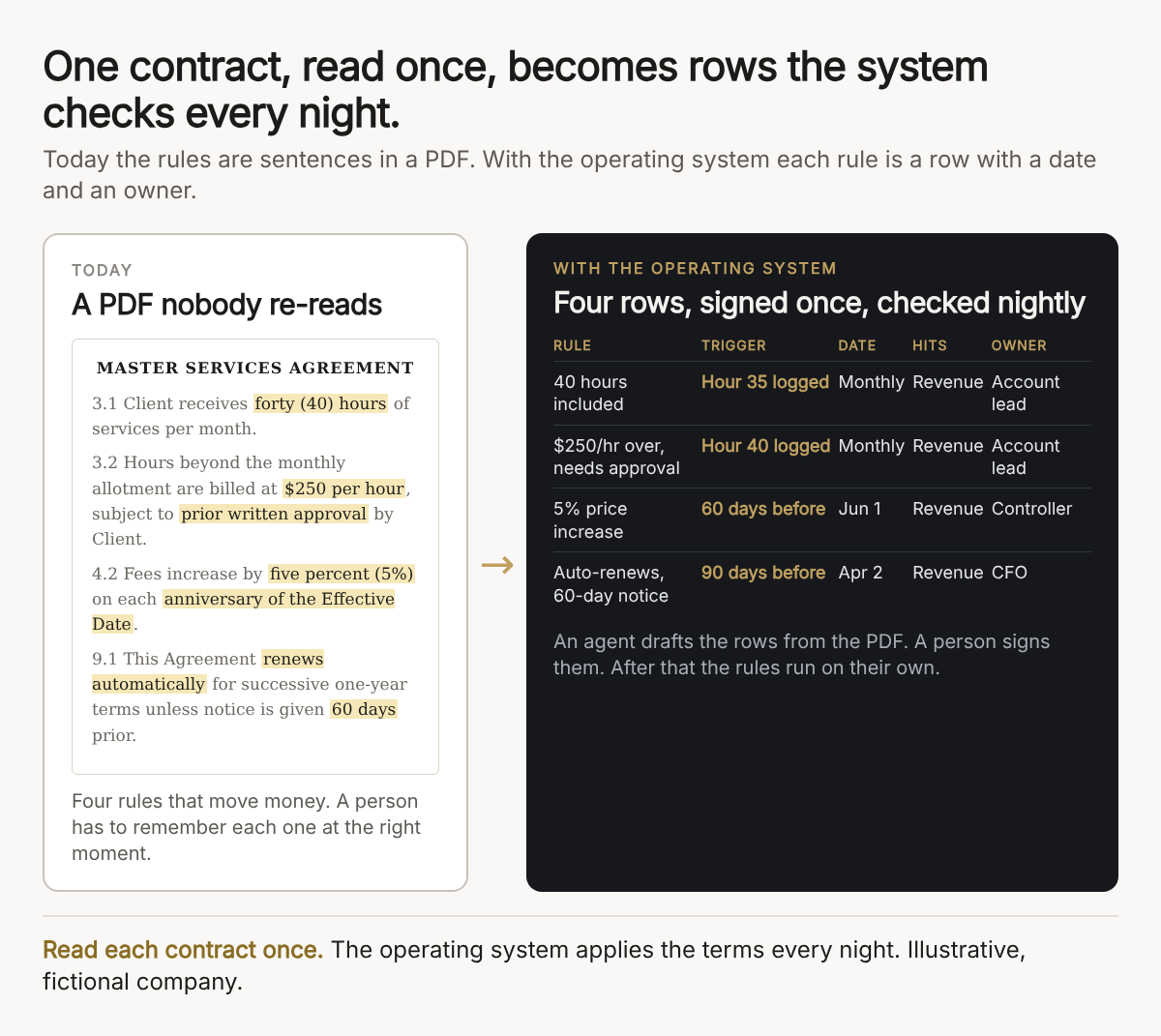
Four rules from one services agreement, as the PDF has them today and as rows the operating system checks every night. Illustrative, fictional company.
How We Would Build It
Connectors copy the contracts and the activity. A connector is a small piece of software that logs into a system and copies out records on a schedule. One copies signed contracts out of the e-signature tool. Others copy invoices, logged hours, and vendor bills out of billing, time tracking, and accounts payable.
One database holds the terms next to the activity. An agent, software that reads a document the way a junior analyst would, drafts the rows from each PDF, and a person confirms them. After that, "2.9% after March 1" and "40 hours included, then $250 an hour" are formulas the database applies on the date (we use Supabase, a hosted database).
Agents watch the counters and the calendar. When an account nears its hour limit, the account lead gets a flag with the approval email already drafted. Sixty days before any fee changes, the CFO gets the new rate and what it does to margin. The agent never changes a term.
A web page shows the next 90 days. Every date that changes a price, a fee, a limit, or a renewal, with the margin effect beside it, and every account near its limit. We build it with an AI coding tool and host it on Vercel.
The model reads the numbers. Excel gets contracted revenue by month with its step-ups, and contracted cost by month with its escalators. The forecast starts from what was signed and only guesses about the rest.
Where This Shows Up
A software company. Every contract allows a 5% price increase at renewal, and the billing system renews at the old price because the increase lives in the PDF. The database applies it on the renewal date.
A consulting firm. Every retainer has an hour limit and an overage rate, and every month some accounts go over without approval. The approval request goes out before the limit is reached, with the hours used so far attached.
A distributor. The supplier contract raises prices with inflation each January and pays a rebate once annual volume passes 500,000 units. The increase shows up in landed cost on January 1, and the rebate gets claimed the week volume crosses the line.
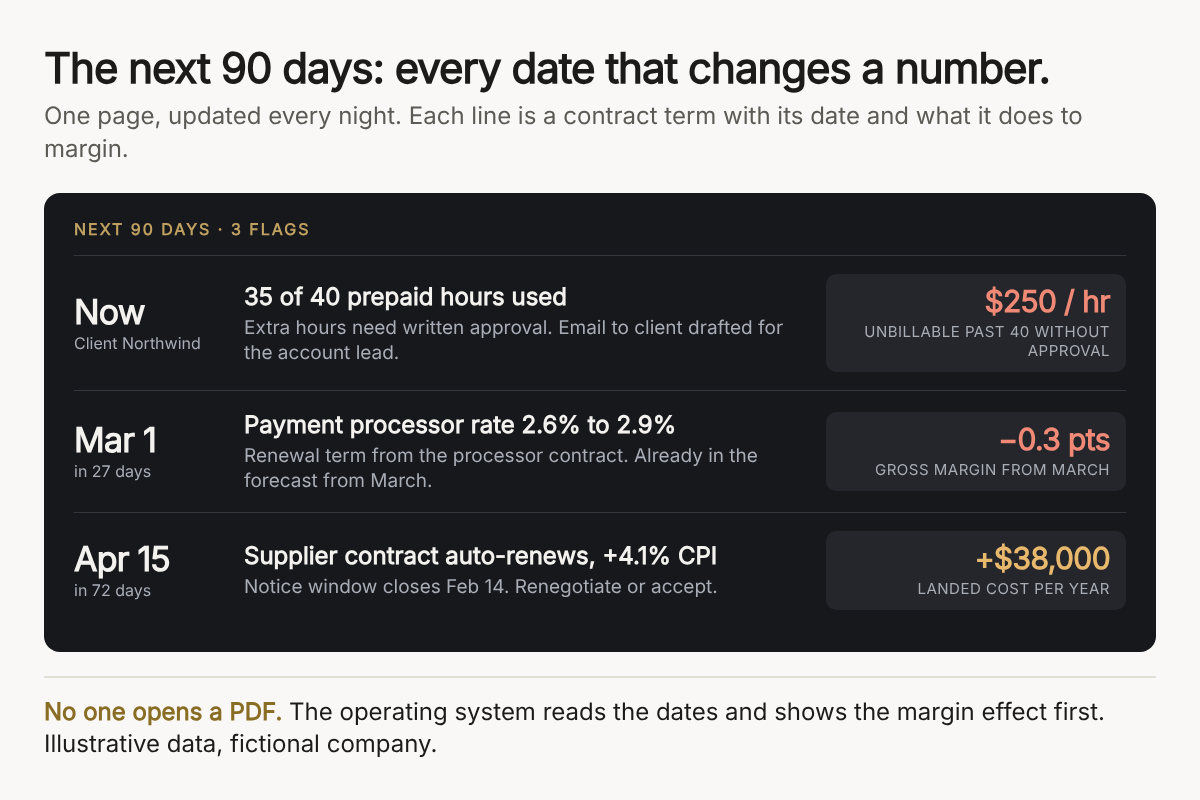
The 90-day page: three contract terms with their dates and what each does to margin. Illustrative data, fictional company.
What Changes for the CFO
Margin moves show up before the date. Every fee change, price increase, and renewal is in the forecast weeks before it takes effect.
Billable work gets billed. Overages and extras get approved before the work happens, so the invoice can include them.
The diligence table already exists. A buyer's first request on a contract-heavy business is every customer contract with its term, renewal date, and change-of-control clause, and that table is already live.
Key Takeaways
The decisions strategic finance already made sit in PDFs, unused by every system that bills, pays, or forecasts.
Read each contract once, sign the rows, and let the system apply the terms every night.
The first version takes 30 days: the top 20 contracts in rows, the 90-day page live, and the model reading contracted revenue for the first time.
QuantFi runs finance for PE- and VC-backed companies, from fractional CFO to full accounting to the finance operating system. Contact us.
The Number
This Week in AI-Native Finance
Anthropic's amended S-1, filed November 2, reports $33.24 billion of revenue and a $104 billion net loss for the nine months ended September 30. Most of the loss is changes in the fair value of convertible notes, derivative liabilities and SAFEs. Purchase commitments and lease agreements total about $895.4 billion, substantially all for compute and infrastructure, and include agreements signed after June 30, so the total is not comparable with the roughly $417 billion reported from the October 26 filing.
ServiceNow CFO Gina Mastantuono said on the company's October 28 third-quarter call that its internal use of AI is now generating more than $1 billion in annualized value, more than double the level it exited 2025 with. She said most of it comes from ServiceNow's own products. CEO Bill McDermott said total headcount has slightly declined, and management said quota-bearing headcount grew at double-digit rates. The company raised its year-end 2026 AI annual contract value target to $1.7 billion.
Microsoft said on October 29 that Copilot for finance now includes more than 25 skills and plugins across Excel, the Copilot app and Copilot Cowork, with a Dynamics 365 ERP plugin that prepares journal entries. The Excel finance skills and the Capital Markets and Finance plugins are generally available, while the account reconciliation and journal entry skills are in early access. In seven days of limited Insider availability, more than 8,000 users invoked the accounting skills more than 44,000 times.
PayPal CEO Enrique Lores said on October 27 that the company's AI chat agents have resolved more than 24 million customer contacts so far this year. Lores said PayPal reduced headcount by more than 2,000 and removed three organizational layers across most of the company. The company said it is on track for at least $1.5 billion of gross run-rate cost savings over two to three years, including more than $700 million exiting the fourth quarter.
Santander said in its third-quarter results on October 28 that AI initiatives generated EUR 194 million of business value in the first nine months of 2026. The bank's first-half presentation defines the metric as incremental revenue, cost savings and lower loan-loss provisions from its data and AI initiatives, measured as annual run-rate against the 2025 baseline. The figure was EUR 35 million in the first quarter and EUR 84 million in the first half.
What We're Reading
Bloomberg reports that private equity firms are adding force majeure-style clauses to buyout loans that let a company stop the clock on a default it attributes to AI disruption. H.I.G. Capital got the language into the EUR 470 million loan behind its Terras Group buyout, according to people familiar with the deal, and lenders reportedly had similar language struck from Bain Capital's EUR 4.7 billion loan for Everllence.
Jeffrey Sonnenfeld, David Siegel and Stephen Henriques argue that the payoff from AI is real but arrives on a longer timeline than markets expect. The piece draws on survey data from McKinsey and a Goldman Sachs estimate of when the growth boost from the AI buildout peaks.
CNBC's earnings-season roundup reports that Santander said AI initiatives generated EUR 194 million of business value in the first nine months of 2026, and that Novartis CEO Vas Narasimhan called this the first quarter in which he has seen AI start to improve the P&L on a tangible basis. It also cites Standard Chartered's CFO saying AI is showing up across the business.
Christian Sanford and Kenny Jen are the co-founders and managing partners of QuantFi, where they help PE- and VC-backed companies build investor-grade finance functions powered by AI-native infrastructure.
Christian came up through investment banking at Barclays ($20B+ in M&A and capital markets), buy-side investing at a hedge fund, and fractional CFO work for investor-backed companies. BBA and MSA in Accounting from Texas Tech.
Kenny led financial strategy at Pilot CFO, Pure Beauty, and Emil Capital Partners after starting his career at Credit Suisse. He has overseen finance for consumer, SaaS, and manufacturing businesses, and works directly with founders on pricing, working capital, and capital allocation. BSBA in Finance from Georgetown.